



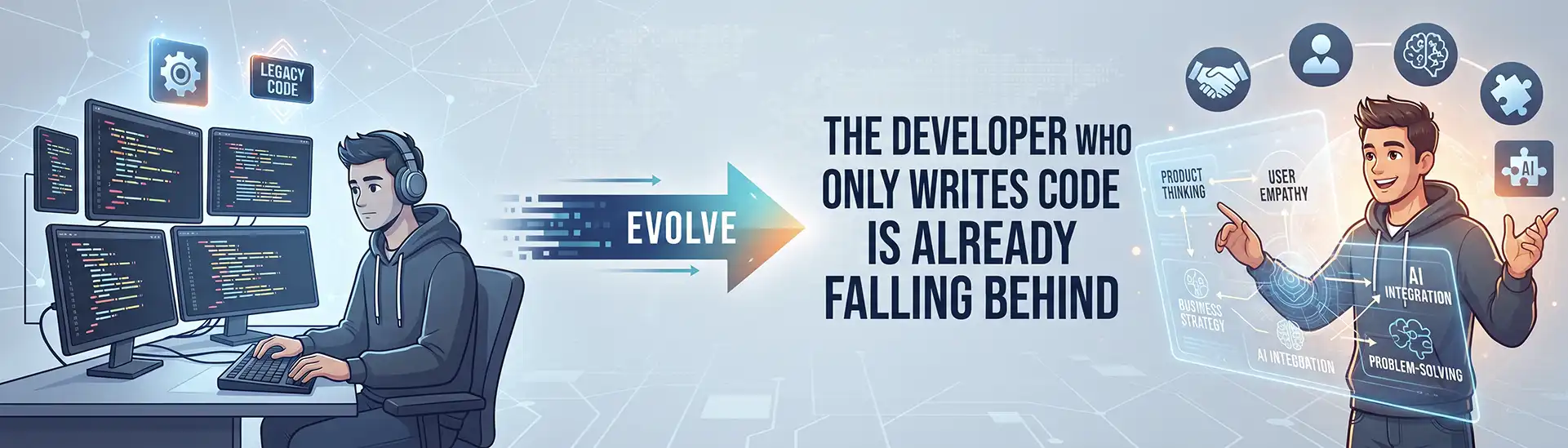
The Developer Who Only Writes Code Is Already Falling Behind
For a long time, being a good developer meant one thing: writing good code. Know your framework, understand databases, build APIs, fix bugs, and deploy applications. But software development is changing. AI can now generate components, write functions, explain errors, create tests, refactor code, and even help developers think through application architecture. So what happens when writing code becomes easier? The value of a developer doesn't disappear. It moves somewhere else.
Code Was Never the Real Skill
Think about it. A client doesn't wake up thinking, "I need someone who knows Laravel." They think, "I need to solve this problem." Maybe they need a better website. Maybe their employees are wasting hours on a manual process. Maybe customers can't complete an application. Maybe their existing system is slow. The technology is simply the tool. The real skill is understanding the problem well enough to build the right solution. That's why I believe the future belongs to developers who can think beyond the code editor.
AI Is Changing the Developer's Job
AI-assisted development is already changing how software gets built. Tasks that previously took hours can sometimes be completed in minutes, including boilerplate code, CRUD interfaces, API integrations, documentation, unit tests, debugging, refactoring, and prototypes. That doesn't mean developers are becoming unnecessary. It means the definition of productive development is changing. If AI can help you write a function in seconds, spending an hour manually writing that function isn't necessarily a competitive advantage. The advantage becomes knowing what function should exist in the first place.
From "How Do I Build It?" to "Should I Build It?"
This is one of the biggest mindset shifts developers can make. A junior developer might ask, "How can I implement this feature?" An experienced developer should sometimes ask, "Do we actually need this feature?" That difference is enormous. Building something is relatively straightforward when the requirements are clear. Figuring out what should be built is much harder. That's where product thinking becomes valuable.
Developers Need to Understand Users
You can build technically perfect software that nobody enjoys using. The backend works, the database is well structured, the APIs are documented, and the deployment is stable. Yet the user experience can still be terrible. Why? Because the developer optimized for the system instead of the person using it. Modern developers need to understand basic UX principles: What does the user want? What are they trying to accomplish? Where might they get confused? What happens when something goes wrong? These questions can be just as important as choosing the right framework.
Business Knowledge Makes Developers More Valuable
A developer who understands business can make better technical decisions. Imagine you're building a lead-generation website. You could simply build a form that stores submissions in a database and call it done. Or you could ask where the leads come from, which campaigns generate the best leads, what information the sales team actually needs, how spam should be detected, whether leads should trigger notifications, which processes can be automated, and how success will be measured. Now you're not just building a form. You're building a business system. That's a completely different level of thinking.
The Full-Stack Developer Is Becoming a Full-Stack Problem Solver
"Full stack" traditionally means knowing both frontend and backend development. But I think the definition is evolving. The modern full-stack developer increasingly needs to understand how people interact with software, how systems process information, how applications run reliably, how data can drive decisions, how AI can augment workflows, how systems protect users, why a product should exist, and what business outcome it is supposed to create. You don't have to become an expert in everything. But understanding how these pieces connect can make you dramatically more effective.
The Best Developers Will Use AIl; Not Compete With It
There's a lot of anxiety around AI replacing developers. I think the more interesting question is: Which developers will become dramatically more productive because of AI? The answer isn't necessarily the developer who knows the most syntax. It's the developer who knows how to define a problem, break it into smaller problems, use AI to accelerate implementation, review the generated solution, test it properly, understand the architecture, deploy it safely, and measure the result. AI can generate code. You still need to own the outcome.
Experience Still Matters
There's another reason experienced developers won't suddenly become irrelevant: software rarely exists in isolation. Real applications have legacy code, existing databases, hosting limitations, security requirements, business constraints, third-party integrations, unpredictable users, and stakeholders who change their minds. The hardest problems aren't always, "How do I write this code?" They're often, "How do I introduce this change without breaking everything else?" That's where experience becomes incredibly valuable.
So, What Should Developers Learn Next?
If you're a developer today, don't abandon your technical skills. Expand them. Learn your framework deeply, but also develop your understanding of product thinking, UX, AI, architecture, security, communication, and business. These skills compound. You don't need to become an expert in every discipline. You need enough understanding to see how your technical decisions affect the product, the business, and the people using it.
The Future Developer
I don't think the future belongs to developers who can write the most code. I think it belongs to developers who can create the most value with the least unnecessary complexity. Sometimes that means writing 1,000 lines of code. Sometimes it means writing 100. And sometimes it means telling the client, "You don't need this feature."
That's not less development. That's better engineering.
The developer of the future isn't simply a person sitting behind a code editor. They're a problem solver, product thinker, system designer, and technology strategist who happens to know how to code. And perhaps that's where software development has been heading all along.