



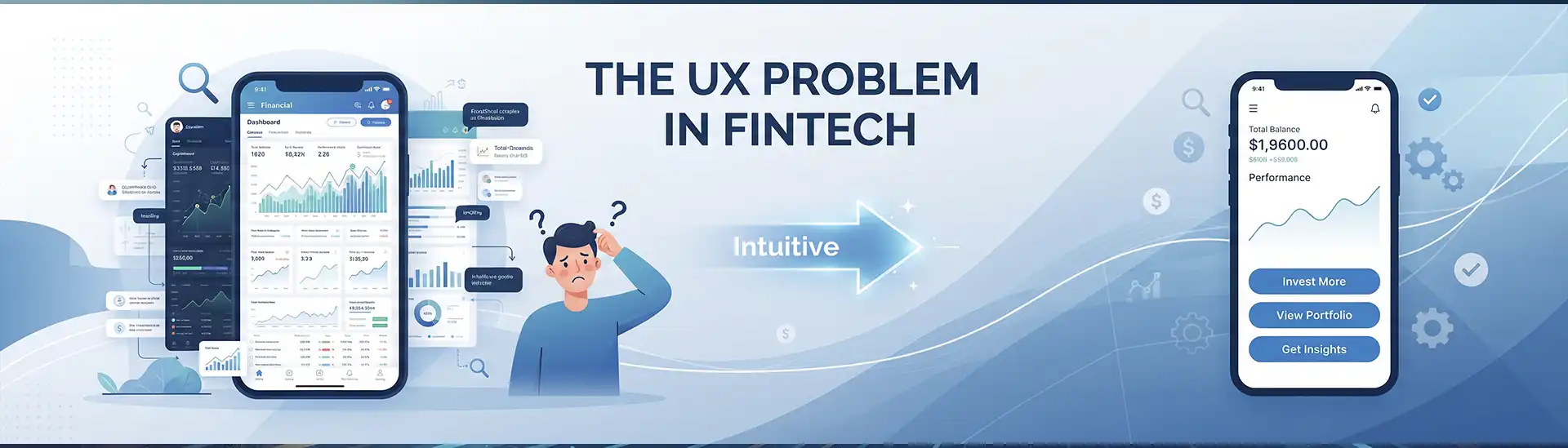
The UX Problem in Fintech: Why Financial Apps Should Be Easier to Use
A financial application can have excellent infrastructure, secure APIs, and a powerful backend. But if users struggle to understand how it works, something important is missing.
Imagine opening an app to check your investment portfolio. You want to know three simple things:
-
How much have I invested?
-
What is the current value?
-
What should I do next?
Instead, you're greeted with unfamiliar terms, crowded dashboards, and menus that make you search for basic information.
The system might be technically impressive. The experience, however, is doing too much work.
In fintech, good UX isn't just about making an application look attractive. It's about making complex financial tasks easier to understand and complete. And as Nepal's digital financial ecosystem continues to evolve, this distinction matters more than ever.
1. Financial Applications Are Different from Ordinary Apps
When users open a social media app, a confusing interface might be annoying. When users open a financial application, confusion can have greater consequences. They may be trying to:
-
Transfer money.
-
Check a transaction.
-
Apply for an IPO.
-
Review their share holdings.
-
Make a payment.
-
Understand an account statement.
These tasks require clarity and confidence. A financial interface should help users understand what they are doing, what will happen next, and whether their action was successful. The objective isn't to remove every feature. It's to organize features around the user's needs.
The best financial interface isn't necessarily the one with the most features. It's the one that makes the right features easy to find.
2. Developers Often Think in Systems. Users Think in Tasks.
This is one of the most interesting differences between software development and user experience design.
A developer might think:
"The API returns the transaction status, the database stores the reference number, and the frontend displays the response."
A user thinks:
"Did my payment go through?"
Both perspectives are necessary, but they aren't identical. A technically correct implementation can still leave users confused.
For example, consider a transaction failure.
A system may return an internal error code such as: TXN_1042
That code might be useful to engineers investigating the problem. It is rarely enough for a user who needs to understand what happened.
A better experience could communicate: Payment not completed
Your bank did not confirm this transaction. Please check your account before trying again. This approach doesn't require sacrificing technical detail. It means presenting the appropriate detail to the appropriate audience.
The lesson for developers
Don't only ask: "Does the feature work?"
Also ask: "Can the user understand what just happened?"
3. Simplicity Doesn't Mean Removing Functionality
There is a common misconception that a simple application must have very few features. That's not necessarily true. A financial platform can offer extensive functionality while still presenting a clear experience. The key is progressive disclosure: show the most important information first and allow users to explore more detail when they need it.
Consider a stock portfolio dashboard. Instead of displaying every available metric on the first screen, the interface could prioritize:

The user gets an overview first. Detailed information remains available without overwhelming the initial screen. Good UX is about prioritization, hierarchy, and context.
4. The Nepalese Market Needs Context-Aware Design
Financial applications aren't built for an abstract global user. They serve people with different levels of financial literacy, technology familiarity, languages, and expectations. In Nepal, digital financial products may need to account for users who are:
-
Opening their first digital financial account.
-
Learning about shares and investments.
-
Managing transactions through a mobile device.
-
Moving between Nepali and English financial terminology.
-
Using slower or less consistent internet connections.
These are design considerations, not assumptions that every user has the same needs.
A better experience could include:
Clear financial terminology
Instead of assuming that everyone understands every financial abbreviation, provide explanations where appropriate.
Accessible navigation
Important actions should be discoverable without requiring users to memorize complex menu structures.
Meaningful feedback
Users should understand whether an action succeeded, failed, or is still processing.
Mobile-first layouts
Financial tasks should remain usable on smaller screens, where space and interaction patterns differ from desktop experiences.
Contextual help
Short explanations, guidance, and support resources can help users navigate unfamiliar processes.
A developer who understands these needs can build more than functional software. They can build software that accommodates different users.
5. Security and Convenience Must Work Together
Security is essential in fintech, but security and usability should not be treated as opposing goals. A user should be protected without being unnecessarily confused.
Consider a login process. A secure system may require multiple verification steps. The user experience should explain those steps clearly, communicate why they're needed when appropriate, and provide useful recovery options. The same principle applies to transactions. Before a user confirms a sensitive action, the application should make important information visible:
-
Recipient or destination.
-
Transaction amount.
-
Applicable charges, where relevant.
-
Confirmation status.
-
Appropriate next steps.
These details help users review actions before committing them. Security protects the system. Good UX helps users interact with those protections correctly. Developers need both.
6. What Developers Can Do Differently
You don't need to be a dedicated UX designer to improve the experiences you build. Small changes in your development process can make a meaningful difference.
Start with the user journey
Before implementing a feature, map the steps a user must complete. For example:
Checking an investment holding
-
Open the investment dashboard.
-
Select the relevant account.
-
Find the holding.
-
View the available details.
-
Return to the overview.
At each step, ask:
-
Is the next action obvious?
-
Is the information understandable?
-
What happens if something goes wrong?
-
Can the user recover without starting over?
This exercise helps reveal friction before the feature is released.
Build for failure, not just success
Many developers design the successful workflow first and treat errors as an afterthought. In financial applications, failure states deserve the same attention as successful ones. Plan for:
-
Network interruptions.
-
Session expiration.
-
Duplicate submissions.
-
Delayed responses.
-
Validation errors.
-
Service unavailability.
The interface should guide the user instead of leaving them guessing.
Use real feedback
Analytics, support requests, usability testing, and direct feedback can reveal where users struggle. Not every problem can be identified through code review. Sometimes the best improvement begins with observing how someone actually uses the application.
7. Where AI Can Help Financial UX
Artificial intelligence creates opportunities to improve how users access and understand financial information. However, AI features should be designed with appropriate safeguards, especially when dealing with financial decisions. Potential applications include:
-
Explaining financial terminology.
-
Summarizing company announcements.
-
Helping users find features within an application.
-
Providing educational guidance for new investors.
-
Organizing information from financial documents.
An AI assistant might explain the difference between market price and portfolio value, for example, without presenting that explanation as personalized investment advice. The most useful AI feature isn't always the one that sounds the most advanced. It's the one that solves a real problem without creating additional confusion or unnecessary risk.
8. The Future Belongs to Developers Who Understand People
The development landscape is changing. AI coding tools can assist with implementation. Frameworks make it easier to build applications. APIs connect services that once required separate systems. As these capabilities become more accessible, technical implementation alone may not be enough to differentiate a product. Understanding the problem becomes increasingly important.
A developer who can:
-
Understand business requirements.
-
Design user journeys.
-
Build reliable systems.
-
Communicate technical limitations.
-
Measure user outcomes.
can contribute to a broader part of the product lifecycle. This doesn't mean every developer needs to become a product manager or designer. It means technical decisions become more valuable when they're connected to the people and problems they serve.
Final Thoughts
Fintech is often discussed through the lens of transactions, infrastructure, digital payments, and innovation. But behind every transaction is a person trying to accomplish something. They want to send money, manage investments, understand a statement, or complete a financial task without unnecessary friction. The responsibility of building better financial applications doesn't belong to one department alone. Designers, developers, product teams, and financial institutions all have a role to play. For developers in Nepal, the opportunity is particularly interesting: contributing to an evolving digital financial ecosystem while learning how software, finance, and human behavior intersect. The next generation of fintech products won't be defined only by what their technology can do. They will also be shaped by how clearly and confidently people can use it.